
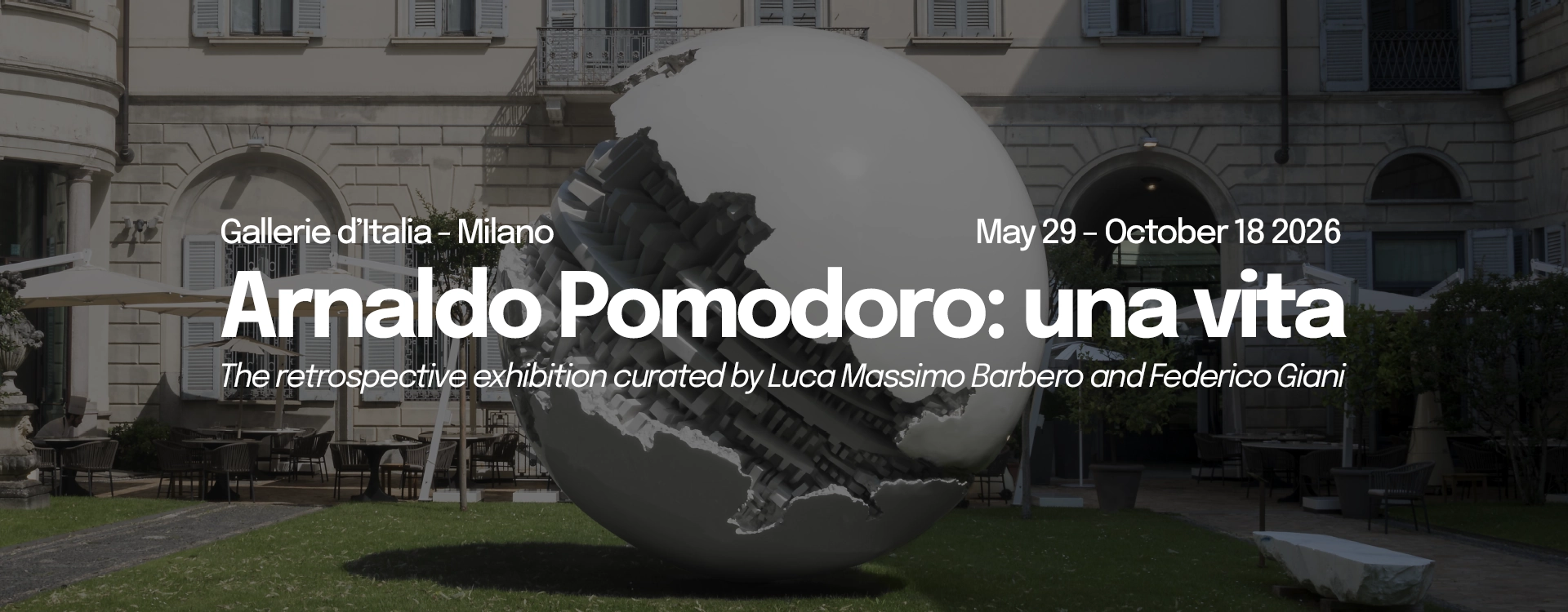
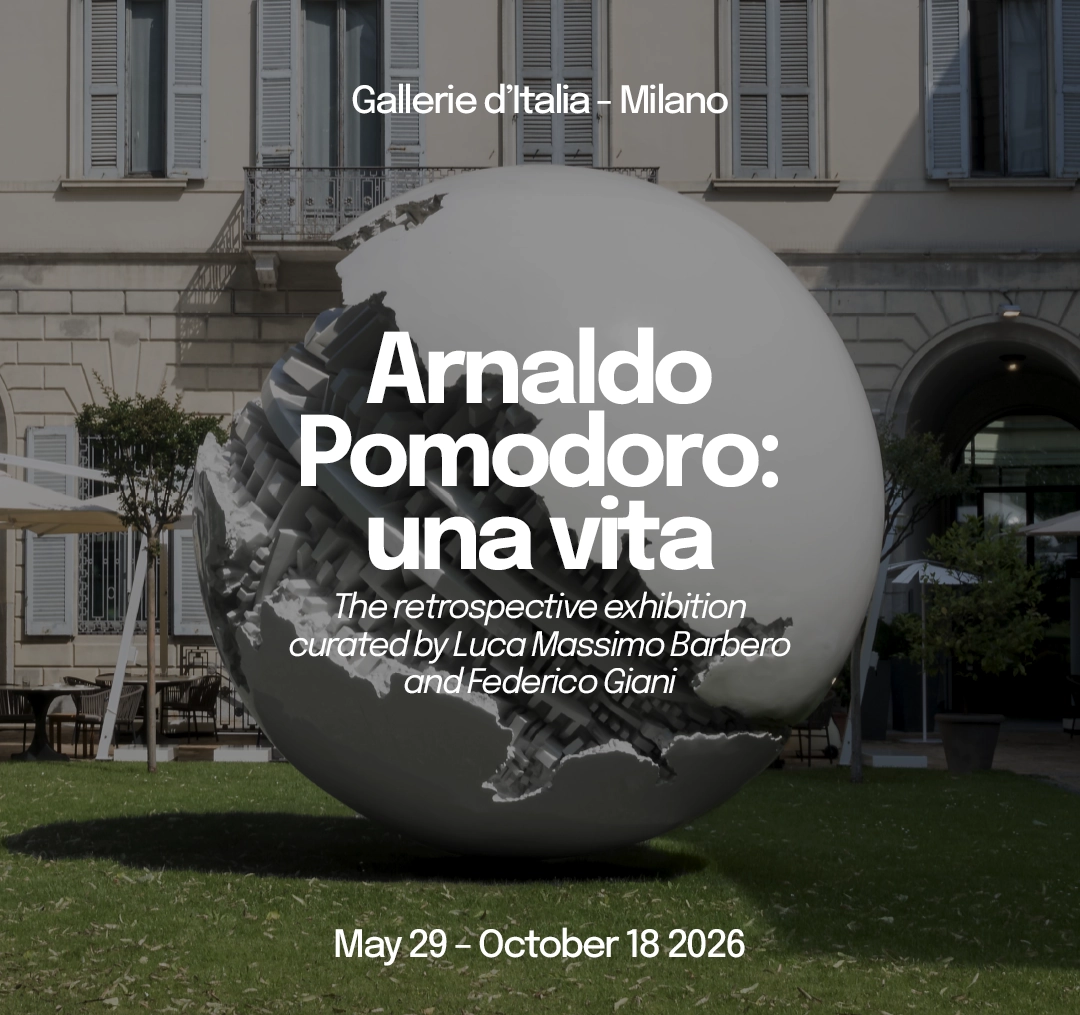
Arnaldo Pomodoro Centenario
arnaldo pomodoro centenario

2026 marks a year of extraordinary significance for the Fondazione Arnaldo Pomodoro, which celebrates the centenary of the birth of the Maestro with a comprehensive program of exhibitions, research projects, educational activities, and events, reaffirming its vocation as a vibrant center for cultural production, dialogue, and experimentation.
1926-1952

Arnaldo Pomodoro was born on June 23, 1926, in Morciano di Romagna. After a few months, his family settled in Orciano di Pesaro, in the Marche region, where Arnaldo spent his childhood.

He attended middle school and the Technical Institute for Surveyors in Rimini, developing a passion for reading contemporary Italian and foreign authors.

After obtaining his diploma as a surveyor, he began working at the Genio Civile in Pesaro (until 1952), then moved to Como (1953), and finally to Milan (from 1954 to 1957).


Photo Archivio Arnaldo Pomodoro, on a journey in front of the Santuario della Madonna della Guardia in Berceto (Parma), 1952


Read the full biography!

Leggi di più

1952-1954

In the early 1950s, in Pesaro, Arnaldo took his first steps into the world of the arts, creating jewelry and set designs.

In 1952, together with his brother Gio’ and Giorgio Perfetti, he formed Gruppo 3P, active until 1956 in the fields of design and applied arts.

In 1954 he moved to Milan and, with the members of 3P, opened a studio in Via Visconti di Modrone, just a few steps away from Lucio Fontana’s studio, who was his point of reference for entering the city's artistic and cultural scene.


Photo Paolo Monti, at work in the studio on via Visconti di Modrone, 1955


Read the full biography!

Leggi di più

1954-1959

During the 1950s, Arnaldo took part in the Milan Triennale (1954 and 1957) and the Venice Biennale (1956).

In 1957, he visited Paris for the first time; in Milan, he joined the Movimento Nucleare and opened a new studio in via Via Orti with his brother Gio’

In 1959, he made his first trip to the United States, traveling between New York and California. He was deeply struck by Brancusi’s works at the MoMA and met many artists, including Duchamp, Mark Rothko, David Smith, Louise Nevelson, and Sam Francis.


Photo Archivio Arnaldo Pomodoro, in Paris with his brother Gio’ and Biagio Semprini, 1957


Read the full biography!

Leggi di più

1960-1965

He took part in the Continuità and in the landmark exhibition Sculture nella città (1962) in Spoleto. He visited Mexico (1961) and returned several times to the United States, where he established professional relationships with the Marlborough Gallery.

His first Spheres, exhibited at the San Paolo Biennal (1963) and the Venice Biennale (1964), were acquired by the GNAM in Rome, Peggy Guggenheim, and the MoMA.

In 1964, he moved his studio to Via Lamarmora and created his first monumental work: a large mural for the Volkshochschule in Cologne.


Photo Ugo Mulas, with Sfera n1, 1963


Read the full biography!

Leggi di più

1966-1970

He taught at Stanford (1966) and at Berkeley (1968-1970)

In 1967, he created his first large-scale Sphere, commissioned by the ministry of Foreign Affairs for the Montreal Expo, later installed in Rome in front of the Farnesina.

From 1967 to 1971, he and Francesco Leonetti led the collective running the magazine Che fare; in 1968, he took part in the occupation of the Milan Triennale and in the protests against the Venice Biennale, resigning from his role as commissioner. In the same year, he moved his studio to Via Vigevano.


Photo Carlo Orsi, working on the Sfera grande for Expo Montreal, 1967


Read the full biography!

Leggi di più

1971-1975

In 1972, he returned to set design, creating the set for Das Käthchen von Heilbronn by Kleist on Lake Zurich, directed by Luca Ronconi.

In 1974, he won the competition for the expansion of the Urbino cemetery with a visionary project that was never realized; in the same year, his first retrospective was held at the Rotonda della Besana in Milan.

In 1975, he visited Iran for the first time and received major commissions from Empress Farah Diba, which were later abandoned due to the Khomeinist Revolution


Photo Nino Lo Duca, opening of the exhibition at the Rotonda della Besana, Milan, 19


Read the full biography!

Leggi di più

1976-1980

In 1976, he exhibited for the first time his first work in progress, The Pietrarubbia Group (1975-1976), while in 1980 he inaugurated a series of exhibitions dedicated to his Visionary Projects; in the same year, he installed the Grande Disco in Piazza Meda in Milan.

In 1978, he visited Japan for the first time. Over the following years, he was invited back several times to exhibit his work and received numerous commissions.

At the invitation of Mills College in Oakland, he resumed teaching in the United States (1979-1984).


Photo Nino Lo Duca, The Pietrarubbia Group installed at the Marlborough Gallery, New York, 1976


Read the full biography!

Leggi di più

1981-1985

He received the Henry Moore Grand Prize from the Hakone Open-Air Museum (1981) and the Ambrogino d’Oro from the Municipality of Milan (1982).

In 1982, he visited Egypt for the first time; in 1983, Vittorio Gregotti renovated is studio; in 1984, the major anthological exhibition Luoghi Fondamentali opened at the Forte di Belvedere in Florence.

At the invitation of the Teatro Massimo in Palermo and the Municipality of Gibellina, during the summers of 1983, 1984, and 1985, he created the set designs forOrestea by Emilio Isgrò, after Aeschylus, performed among the ruins of Gibellina.


Photo Archivio Arnaldo Pomodoro, installation of the set design for Agamènnuni on the ruins of Gibellina, 1983


Read the full biography!

Leggi di più

1986-1990

In 1988, he was invited for the third time to the Venice Biennale with a solo room; in the same year, he visited Australia for the first time.

From 1988 to 1989, he served as head of the Plastic Arts Group of the EEC Committee of Cultural Consultants.

In 1990, he won the Praemium Imperiale of the Japan Art Association and the Premio UBU; in the same year, he founded the Centro TAM - Trattamento Artistico dei Metalli in Pietrarubbia, in the Marche region, and inaugurated Sfera con sfera in the Cortile della Pigna of the Vatican Museums.


Photo Archivio Arnaldo Pomodoro, celebrations at the end of the installation of Sfera con sfera in the Cortile della Pigna of the Musei Vaticani, 1990


Read the full biography!

Leggi di più

1991-1995

In 1991, he visited Tunisia and Turkey for the first time, while in the winter of 1993-1994 he travelled to Bali.

In 1992, he won the Premio UBU for the second time, and Trinity College Dublin awarded him an honorary degree in Literature honoris causa; in the same year, L’arte lunga, a dialogue written jointly with Francesco Leonetti, was published by Feltrinelli.

In 1995, he established the Fondazione Arnaldo Pomodoro and began renovating its first exhibition space in Rozzano (1996-2004).


Photo Archivio Arnaldo Pomodoro, with Franco Quadri and Cherif at the Roman amphitheater of El Jem in Tunisia, 1991


Read the full biography!

Leggi di più

1996-2000

In 1996, for the 50th anniversary of the founding of the UN, a Sfera con sfera donated by the Italian government was installed in the United Nations Plaza in New York.

In the winter of 1996-1997, he traveled to Yemen. In 1997-1998, a memorable solo exhibition was held in San Leo, in the Montefeltro region. In 1998, he was commissioned to redesign the Sala d’Armi at the Museo Poldi Pezzoli, inaugurated in 2000.

In 1999, the Foundation officially opened its activities to the public at its Rozzano headquarters.


Photo Ermanno Casasco, inauguration of Sfera con sfera, Piazzale delle Nazioni Unite, New York, 1996


Read the full biography!

Leggi di più

2001-2011

During the first decade of the 2000s, he created his last major works, such as Novecento (2000-2002) for Piazzale Nervi in Rome, Grande Portale Marco Polo o (1988–2008) presented at the 2010 Shanghai Expo, and Carapace (2005-2012) for the Tenute Lunelli estate in Bevagna.

In 2001, the University of Ancona awarded him an honorary degree in Architectural Engineering.

In 2005, the Foundation moved to Via Solari 35 in Milan: in the underground spaces, Pomodoro installedthe environment Ingresso nel labirinto (1995-2011).


Photo Carlo Orsi, working on Novecento in the spaces of the former Riva Calzoni, Milan, 2000


Read the full biography!

Leggi di più

2012-2023

After closing the Via Solari 35 headquarters, in 2013 the Foundation moved to Via Vigevano, and from 2022–2023 it began operating in the spaces of Pomodoro’s studio.

In 2012, his work as a set designer was celebrated in a major exhibition at Palazzo Reale in Turin and in the book Il teatro scolpito , published by Skira.

To celebrate his ninetieth birthday, in 2016 the City of Milan honored him with a retrospective exhibition at Palazzo Reale, accompanied by related events at the Foundation, the Museo Poldi Pezzoli, and the Triennale.


Photo Carlos Tettamanzi, with Gillo Dorfles at the opening of Pomodoro’s exhibition at Palazzo Reale, Milan, 2016


Read the full biography!

Leggi di più

2024-2025

In 2024, the cataloging of his entire work, conducted under his supervision, was completed on the online Catalogue Raisonné.

On June 22, 2025, just hours before his ninety-ninth birthday, Arnaldo Pomodoro peacefully passed away at his home in Milan, leaving behind an immense legacy, not only for the power of his work, recognized internationally, but also for the coherence and depth of his thought, always capable of looking to the future with tireless creative energy.


Photo Carlo Orsi, in Venice, 2014


Read the full biography!

Leggi di più
arnaldo pomodoro una vita la grande mostra antologica

The Arnaldo Pomodoro Sculpture Prize

In 2026, the exhibition of the finalists of the 8th edition of the Arnaldo Pomodoro Sculpture Prize will take place, reconceived and curated on this occasion together with Fondazione ICA Milano.

Bronwyn Katz (1993 – Kimberley, South Africa), Dan Lie (1988), Công Tùng Trương (1986 – Dak Lak, Vietnam), Luana Vitra (1995 – Contagem, Brazil), and Yu Ji (1985 – Shanghai, China) are invited to present a new work in a group exhibition scheduled at Fondazione ICA Milano from 13 April to 10 July 2026, curated by Federico Giani and Chiara Nuzzi.

Find out more!

Festival Orizzonte | Parole, immagini e musica per edificare il futuro

In 2026, the Fondazione’s public program, with the festival ORIZZONTE | Parole, immagini e musica per edificare il futuro curated by Giovanni Caccamo, will host PIF, Stefano Accorsi, Tananai, and Agadez.

The festival thus reaffirms the Foundation's desire to be an open cultural laboratory, capable of engaging diverse audiences and looking to the future through the comparison of artistic and human experiences.

It is also announced that, to relive the emotions of past festival events, a podcast will be launched on all digital platforms, with each episode dedicated to a guest from previous editions.

Main sponsor: Alessia Zanelli

Photo Francesco Mazzei, Gianni Morandi and Giovanni Caccamo during an ORIZZONTE event, 2025.

Donation of Arnaldo Pomodoro's Art History Library to the University of Milan

Comprising approximately 5,000 volumes and 100 series of periodicals collected by the artist throughout his life as a tool for study and inspiration, the Maestro's library will be transferred to the University's Library of Art History, Music and Performing Arts, which will catalogue it and ensure its public and free use, creating a special Arnaldo Pomodoro Collection.

Photo Archive Arnaldo Pomodoro, Arnaldo Pomodoro's art history library set up between 2005 and 2011 in the former headquarters of the Foundation in Via Solari, Milan.

Commemorative coin dedicated to Arnaldo Pomodoro

As a high institutional honor to Arnaldo Pomodoro, recognized as a prominent figure in the country’s culture, the Ministry of Economy and Finance will issue a coin dedicated to him, which will be produced by the Istituto Poligrafico e Zecca dello Stato as part of the Numismatic Collection ’26.

Photograph by ©SALVOGALANO

Catalogue Raisonné on the Blockchain

To ensure the integrity of data and due diligence activities, the Foundation will initiate the registration of the Catalogue Raisonné on the blockchain, entrusting its development to Officinebit.ch, in collaboration with the Foundation’s legal firm.

The project will be integrated into the Swiss Ledger infrastructure, the Swiss institutional blockchain based in Lugano, making the Arnaldo Pomodoro Foundation the first concrete case of using this platform for the certification of artworks, with high standards of security, traceability, and data protection.

Photo by Carlo Orsi, Pomodoro overlooking the Cortile della Pigna at the Vatican Museums, 1990

Mostra sulla Collezione della Fondazione

The 2026 exhibition program of the Arnaldo Pomodoro Foundation will continue in the second half of the year with a show at its premises, located at Via Vigevano 3, dedicated to the Foundation’s Collection. Through works by other artists and archival materials, the public will be able to discover the many stories of friendship and collaboration that connected Arnaldo Pomodoro with key figures of Italian and international art of the late twentieth century (Lucio Fontana, Gastone Novelli, Alighiero Boetti, Louise Nevelson, Rufino Tamayo…), as well as the history of the Foundation and its Collection.

Photo Arnaldo Pomodoro Archive, Alighiero Boetti, Senza titolo (1978), Fondazione Arnaldo Pomodoro Collection

Collaboration with Gibellina, Capital of Contemporary Art 2026

In 2026, the dialogue with Sicily is renewed—a place dear to the artist, with which he maintained an intense and long-standing relationship, marked by projects, theatrical productions, friendships, and public works.

A collaboration will be launched between the Foundation’s Educational Department and the Museo delle Trame Mediterranee in Gibellina on the occasion of the city’s designation as Capital of Contemporary Art 2026. On the same occasion, the Festival delle Orestiadi pays tribute to Arnaldo Pomodoro through an original project: four performances spanning music, dance, and theatre, inspired by the characters of Emilio Isgrò’s Orestea, to “restage” today the scenic machines conceived by Arnaldo Pomodoro in 1983.

Photo from the Arnaldo Pomodoro Archive, installation of the set design for *Agamènnuni* on the ruins of Gibellina, 1983

Enhancement and dissemination of the heritage

Within this perspective of collaboration with Sicilian institutions falls the loan of the model for the Porta dei Re of Cefalù Cathedral (1997–1998), which will be exhibited at Palazzo Branciforte in Palermo, as well as the exhibition of the Project for the Monument in Memory of Giovanni Falcone (1992) at the Museo del Presente Giovanni Falcone and Paolo Borsellino in Palermo, thanks to the synergy with the Falcone Foundation.

Photo by Carlo Orsi, with Federico Zeri during the presentation of the model for the Porta dei Re of Cefalù Cathedral, 1998

Documentary Arnaldo Pomodoro - La natura della forma

In 2026, the documentary Arnaldo Pomodoro – La natura della forma will be presented, written and directed by Alessandro Pezza and produced by Studiozabalik, with the scientific consultancy of the Foundation. The film uses archival materials, interviews, and footage to create a new, emotional, and engaging portrait of the artist, exploring the relationship between art and nature—a constant theme in the Maestro’s work.

Soliera honors Arnaldo Pomodoro

The city of Soliera will take part in the centenary celebrations, continuing the path begun in 2020 with the exhibition at Castello Campori and the loan of the Obelisco di Cleopatra (1989–2008) in Piazza Lusvardi, which today hosts Lancia di Luce II (1985). In October, Soliera will dedicate an exhibition to Arnaldo Pomodoro with the aim of further strengthening the dialogue between public space and contemporary art, and consolidating the connection between the city, the Maestro, and the Arnaldo Pomodoro Foundation.

Photo Lancia di Luce II, piazza Lusvardi, Soliera

Municipio Roma IX honors Arnaldo Pomodoro

The Rome IX Eur Municipality has promoted an initiative for the restoration and enhancement of the Novecento Obelisk (2000–2002), located in Piazzale Pier Luigi Nervi, the gateway to Rome for those arriving from southern Lazio. It will take part in the 2026 celebrations with its own public cultural initiatives, aiming to establish a technical-scientific committee involving all relevant stakeholders in the promotion of the artwork and its urban context.

Photo by Carlo Orsi, Novecento in Piazzale Pier Luigi Nervi, Rome