
Arnaldo Pomodoro Centenario
arnaldo pomodoro centenario

1926-1952

Arnaldo Pomodoro was born on June 23, 1926, in Morciano di Romagna. After a few months, his family settled in Orciano di Pesaro, in the Marche region, where Arnaldo spent his childhood.

He attended middle school and the Technical Institute for Surveyors in Rimini, developing a passion for reading contemporary Italian and foreign authors.

After obtaining his diploma as a surveyor, he began working at the Genio Civile in Pesaro (until 1952), then moved to Como (1953), and finally to Milan (from 1954 to 1957).


Photo Archivio Arnaldo Pomodoro, on a journey in front of the Santuario della Madonna della Guardia in Berceto (Parma), 1952


Read the full biography!

Leggi di più

1952-1954

In the early 1950s, in Pesaro, Arnaldo took his first steps into the world of the arts, creating jewelry and set designs.

In 1952, together with his brother Gio’ and Giorgio Perfetti, he formed Gruppo 3P, active until 1956 in the fields of design and applied arts.

In 1954 he moved to Milan and, with the members of 3P, opened a studio in Via Visconti di Modrone, just a few steps away from Lucio Fontana’s studio, who was his point of reference for entering the city's artistic and cultural scene.


Photo Paolo Monti, at work in the studio on via Visconti di Modrone, 1955


Read the full biography!

Leggi di più

1954-1959

During the 1950s, Arnaldo took part in the Milan Triennale (1954 and 1957) and the Venice Biennale (1956).

In 1957, he visited Paris for the first time; in Milan, he joined the Movimento Nucleare and opened a new studio in via Via Orti with his brother Gio’

In 1959, he made his first trip to the United States, traveling between New York and California. He was deeply struck by Brancusi’s works at the MoMA and met many artists, including Duchamp, Mark Rothko, David Smith, Louise Nevelson, and Sam Francis.


Photo Archivio Arnaldo Pomodoro, in Paris with his brother Gio’ and Biagio Semprini, 1957


Read the full biography!

Leggi di più

1960-1965

He took part in the Continuità and in the landmark exhibition Sculture nella città (1962) in Spoleto. He visited Mexico (1961) and returned several times to the United States, where he established professional relationships with the Marlborough Gallery.

His first Spheres, exhibited at the San Paolo Biennal (1963) and the Venice Biennale (1964), were acquired by the GNAM in Rome, Peggy Guggenheim, and the MoMA.

In 1964, he moved his studio to Via Lamarmora and created his first monumental work: a large mural for the Volkshochschule in Cologne.


Foto: Ugo Mulas. Fotografie Ugo Mulas © Eredi Ugo Mulas. Tutti i diritti riservati.


Read the full biography!

Leggi di più

1966-1970

He taught at Stanford (1966) and at Berkeley (1968-1970)

In 1967, he created his first large-scale Sphere, commissioned by the ministry of Foreign Affairs for the Montreal Expo, later installed in Rome in front of the Farnesina.

From 1967 to 1971, he and Francesco Leonetti led the collective running the magazine Che fare; in 1968, he took part in the occupation of the Milan Triennale and in the protests against the Venice Biennale, resigning from his role as commissioner. In the same year, he moved his studio to Via Vigevano.


Foto Carlo Orsi, al lavoro sulla Sfera grande per l'Expo Montreal, 1967


Read the full biography!

Leggi di più

1971-1975

Nel 1972 torna alla scenografia allestendo la Das Kätchen von Heilbronn di Kleist sul lago di Zurigo con la regia di Luca Ronconi.

In 1974, he won the competition for the expansion of the Urbino cemetery with a visionary project that was never realized; in the same year, his first retrospective was held at the Rotonda della Besana in Milan.

In 1975, he visited Iran for the first time and received major commissions from Empress Farah Diba, which were later abandoned due to the Khomeinist Revolution


Photo Nino Lo Duca, opening of the exhibition at the Rotonda della Besana, Milan, 19


Read the full biography!

Leggi di più

1976-1980

In 1976, he exhibited for the first time his first work in progress, The Pietrarubbia Group (1975-1976), mentre nel 1980 inaugura una serie di mostre dedicate ai suoi Progetti visionari; lo stesso anno installa il Grande disco in Piazza Meda a Milano.

In 1978, he visited Japan for the first time. Over the following years, he was invited back several times to exhibit his work and received numerous commissions.

At the invitation of Mills College in Oakland, he resumed teaching in the United States (1979-1984).


Foto Nino Lo Duca, The Pietrarubbia Group installata alla Marlborough Gallery, New York, 1976


Read the full biography!

Leggi di più

1981-1985

Riceve l’Henry Moore Grand Prize dall’Hakone Open-Air Museum (1981) e l’Ambrogino d’oro dal Comune di Milano (1982).

Nel 1982 visita per la prima volta l’Egitto; nel 1983 Vittorio Gregotti ristruttura il suo studio; nel 1984 si apre al Forte di Belvedere di Firenze la grande mostra antologica Luoghi Fondamentali.

At the invitation of the Teatro Massimo in Palermo and the Municipality of Gibellina, during the summers of 1983, 1984, and 1985, he created the set designs forOrestea by Emilio Isgrò, after Aeschylus, performed among the ruins of Gibellina.


Foto Archivio Arnaldo Pomodoro, allestimento della scenografia di Agamènnuni sui ruderi di Gibellina, 1983


Read the full biography!

Leggi di più

1986-1990

In 1988, he was invited for the third time to the Venice Biennale with a solo room; in the same year, he visited Australia for the first time.

From 1988 to 1989, he served as head of the Plastic Arts Group of the EEC Committee of Cultural Consultants.

Nel 1990 vince il Praemium Imperiale della Japan Art Association e il Premio UBU; lo stesso anno fonda il Centro TAM - Trattamento Artistico dei Metalli a Pietrarubbia, nelle Marche, e inaugura la Sfera con sfera in the Cortile della Pigna of the Vatican Museums.


Foto Archivio Arnaldo Pomodoro, festeggiamenti al termine dell'installazione di Sfera con sfera nel Cortile della Pigna dei Musei Vaticani, 1990


Read the full biography!

Leggi di più

1991-1995

In 1991, he visited Tunisia and Turkey for the first time, while in the winter of 1993-1994 he travelled to Bali.

In 1992, he won the Premio UBU for the second time, and Trinity College Dublin awarded him an honorary degree in Literature honoris causa; in the same year, L’arte lunga, a dialogue written jointly with Francesco Leonetti, was published by Feltrinelli.

In 1995, he established the Fondazione Arnaldo Pomodoro and began renovating its first exhibition space in Rozzano (1996-2004).


Photo Archivio Arnaldo Pomodoro, with Franco Quadri and Cherif at the Roman amphitheater of El Jem in Tunisia, 1991


Read the full biography!

Leggi di più

1996-2000

In 1996, for the 50th anniversary of the founding of the UN, a Sfera con sfera donated by the Italian government was installed in the United Nations Plaza in New York.

In the winter of 1996-1997, he traveled to Yemen. In 1997-1998, a memorable solo exhibition was held in San Leo, in the Montefeltro region. In 1998, he was commissioned to redesign the Sala d’Armi at the Museo Poldi Pezzoli, inaugurated in 2000.

In 1999, the Foundation officially opened its activities to the public at its Rozzano headquarters.


Foto Ermanno Casasco, inaugurazione di Sfera con sfera, Piazzale delle Nazioni Unite, New York, 1996


Read the full biography!

Leggi di più

2001-2011

Lungo il primo decennio degli anni Duemila realizza le ultime grandi opere, come Novecento (2000-2002) per Piazzale Nervi a Roma, il Grande Portale Marco Polo o (1988–2008) presented at the 2010 Shanghai Expo, and Carapace (2005-2012) for the Tenute Lunelli estate in Bevagna.

Nel 2001 l’Università di Ancona gli conferisce la Laurea honoris causa in Ingegneria Edile-Architettura.

In 2005, the Foundation moved to Via Solari 35 in Milan: in the underground spaces, Pomodoro installedthe environment Ingresso nel labirinto (1995-2011).


Foto Carlo Orsi, lavorazione di Novecento negli spazi della ex Riva Calzoni, Milano, 2000


Read the full biography!

Leggi di più

2012-2023

After closing the Via Solari 35 headquarters, in 2013 the Foundation moved to Via Vigevano, and from 2022–2023 it began operating in the spaces of Pomodoro’s studio.

In 2012, his work as a set designer was celebrated in a major exhibition at Palazzo Reale in Turin and in the book Il teatro scolpito , published by Skira.

To celebrate his ninetieth birthday, in 2016 the City of Milan honored him with a retrospective exhibition at Palazzo Reale, accompanied by related events at the Foundation, the Museo Poldi Pezzoli, and the Triennale.


Photo Carlos Tettamanzi, with Gillo Dorfles at the opening of Pomodoro’s exhibition at Palazzo Reale, Milan, 2016


Read the full biography!

Leggi di più

2024-2025

In 2024, the cataloging of his entire work, conducted under his supervision, was completed on the online Catalogue Raisonné.

On June 22, 2025, just hours before his ninety-ninth birthday, Arnaldo Pomodoro peacefully passed away at his home in Milan, leaving behind an immense legacy, not only for the power of his work, recognized internationally, but also for the coherence and depth of his thought, always capable of looking to the future with tireless creative energy.


Photo Carlo Orsi, in Venice, 2014


Read the full biography!

Leggi di più

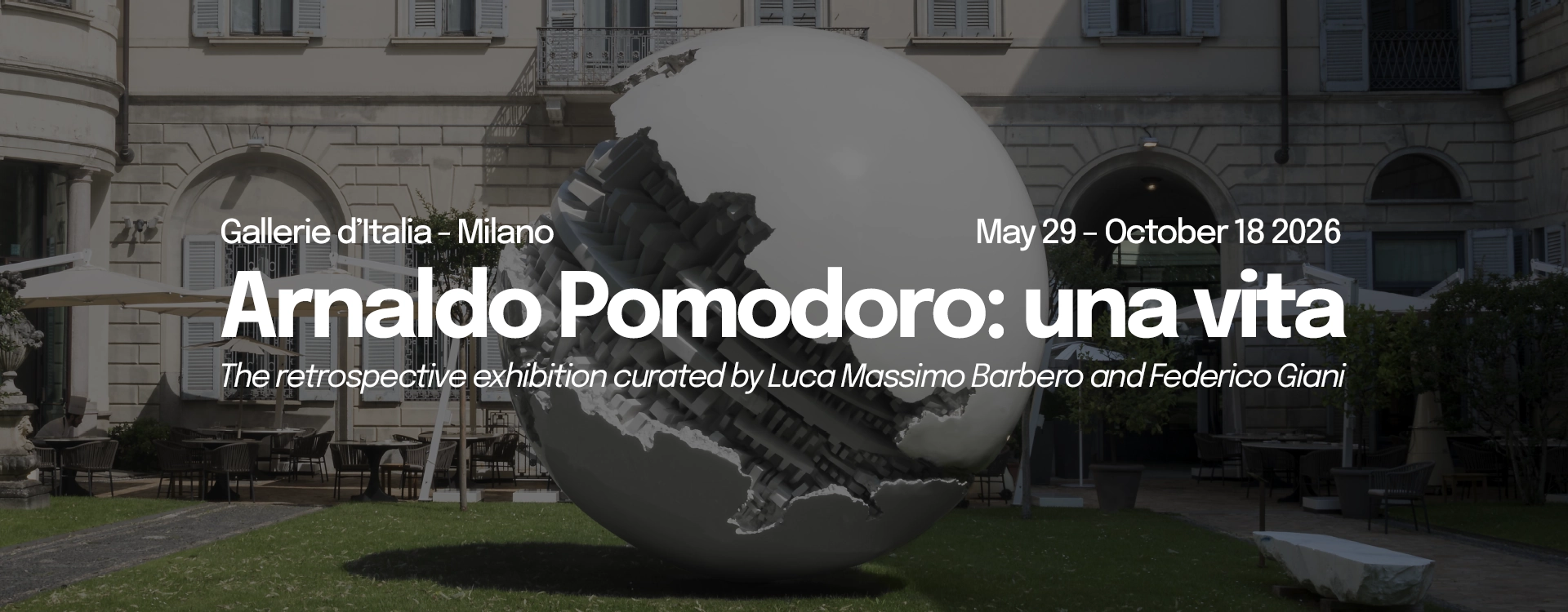
Arnaldo Pomodoro. Una vita

Find out more!

La Milano di Pomodoro

Scarica la mappa illustrata!

The Arnaldo Pomodoro Sculpture Prize

Find out more!

Donation of Arnaldo Pomodoro's Art History Library to the University of Milan

Open Studio #5 | La Collezione di Arnaldo Pomodoro - Vol.I

Commemorative coin dedicated to Arnaldo Pomodoro

Festival Orizzonte | Parole, immagini e musica per edificare il futuro

Catalogue Raisonné on the Blockchain

Collaboration with Gibellina, Capital of Contemporary Art 2026

Enhancement and dissemination of the heritage

Documentary Arnaldo Pomodoro - La natura della forma

Soliera honors Arnaldo Pomodoro

Municipio Roma IX honors Arnaldo Pomodoro